Downloading OBS Studio for Mac is a short job once you know which of the two disk images your Mac needs. This guide covers the current release, OBS Studio 33.0.1, released on October 29, 2026, and walks through choosing between the Apple Silicon and Intel files, getting the right one from an official source, and checking it before you open it. OBS Studio is free and open-source software under the GPLv2 licence or later, so there is no payment, licence key, or account to create, and the download is the complete program. The Mac version needs macOS 13.0 or newer, so confirming your macOS version first is part of the process.
What the Mac download gives you
OBS Studio, short for Open Broadcaster Software Studio, is a free program for recording your screen and streaming live video. Once installed on your Mac, you can capture your display, a single application window, or a camera, mix audio from your microphone and your Mac, arrange video sources into scenes, and stream live or record to a file. Many people use it only as a recorder, for lessons, presentations, and tutorials, and never stream at all. The download itself is a disk image file ending in.dmg: you open it, and it shows you the OBS Studio application to copy into your Applications folder.
There are two Mac disk images, and they are not interchangeable. One is built for Apple Silicon Macs, those with an Apple M1, M2, M3, M4, or later chip; the other is built for Intel Macs. Downloading the wrong one is the most common Mac download mistake, and it is easy to avoid by checking your Mac first, as Section 2 explains. The disk image contains only OBS Studio; it does not include a streaming account, a video editor, or any bundled extra software when you get it from the official source, and it never asks you to sign in or install a download manager.
Apple Silicon or Intel: check your Mac
Click the Apple menu in the top-left corner of your screen and choose About This Mac. The window shows your macOS version and your chip: it will say Apple M1, M2, M3, M4, or a similar Apple chip name, or it will say Intel, followed by the processor model. If it says Apple, download the Apple Silicon disk image; if it says Intel, download the Intel disk image. The file names match this split: the Apple Silicon file is OBS-Studio-33.0.1-macOS-Apple.dmg and the Intel file is OBS-Studio-33.0.1-macOS-Intel.dmg.
On the same About This Mac window, check your macOS version. OBS Studio 33.0.1 needs macOS 13.0 or newer. If your Mac runs an older version, the current disk image is not the right file for you; check the official OBS Project pages for guidance on older releases rather than trying to force it to open. Also check you have a few hundred megabytes free for the application, and much more free space for recordings, since video files grow quickly. A stable internet connection matters more than a fast one: the Apple Silicon image is 199.9 MB and the Intel image is 211.6 MB, and an unstable connection can leave you with an incomplete file.
Where to download OBS Studio safely
The safest place to get OBS Studio is from the official OBS Project distribution channels. The official website is obsproject.com, its download page is obsproject.com/download, and the release files are also listed on the project's GitHub releases page at github.com/obsproject/obs-studio/releases. The links in this guide point directly to those official files. OBS Descargar is an independent guide site, not the official OBS Project site, and we do not modify, bundle, or repackage the download.
The source matters because OBS Studio is popular and free, so copycat download sites are common. Some wrap the real download in their own installer that adds unwanted software; others host modified files. A safe page has recognisable signs: the address belongs to obsproject.com or github.com/obsproject, the file name matches the official release exactly, and the page never asks you to install a download manager or browser extension first. Be suspicious of any site promising a "cracked", "pro", or "premium" version, because no such version exists. The official page always offers the latest release, currently 33.0.1; a page offering a much older version without explaining why is probably not official.
Downloading the Apple Silicon disk image
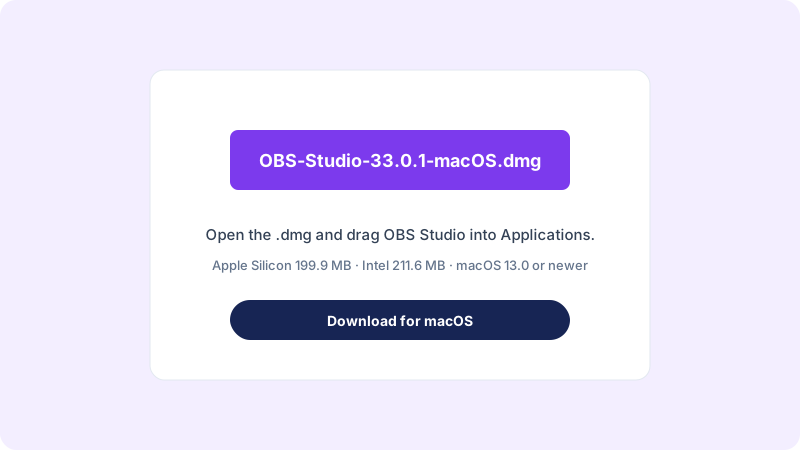
Most Macs sold in recent years use Apple Silicon, so most readers need this file: OBS-Studio-33.0.1-macOS-Apple.dmg, at 199.9 MB. You can download it directly from the official GitHub releases page at the link below. Clicking the link should start the download in your browser, or prompt you to choose where to save the file.
Download OBS Studio 33.0.1 for Mac, Apple Silicon (.dmg, 199.9 MB)
- Confirm in About This Mac that your chip is Apple Silicon and your macOS is 13.0 or newer.
- Open your browser and go to the official OBS Project download page, or click the direct link above.
- Confirm the page offers OBS Studio 33.0.1 with macOS selected.
- Click the download link and save the file to a location you will remember, such as Downloads.
- Wait until the download finishes completely; your browser shows progress in its downloads area.
- Check the finished file is named OBS-Studio-33.0.1-macOS-Apple.dmg and is about 199.9 MB.
A normal download ends quietly: the browser reports completion, and the file sits in your folder with the correct name and size. If the size is much smaller than 199.9 MB, the download stopped early; delete the partial file and try again rather than opening it. If you prefer the official download page to the direct link, the same file is offered there when you choose macOS and Apple Silicon; the file is identical, only the route differs.
Downloading the Intel disk image
If your Mac has an Intel processor, the Apple Silicon disk image is not the right file, and you should not try to open it. Instead, download the Intel disk image: OBS-Studio-33.0.1-macOS-Intel.dmg, at 211.6 MB, from the official GitHub releases page at the link below. The steps are the same as for Apple Silicon, with only the file name and size differing, so the checklist below will look familiar.
Download OBS Studio 33.0.1 for Mac, Intel (.dmg, 211.6 MB)
- Confirm in About This Mac that your processor is Intel and your macOS is 13.0 or newer.
- Click the Intel link above, or find the same file on the official download page or GitHub releases page.
- Save the file to Downloads and wait for the download to finish completely.
- Check the file is named OBS-Studio-33.0.1-macOS-Intel.dmg and is about 211.6 MB.
- Leave the file in Downloads until you are ready to install it.
Intel Macs are older machines, so it is worth a reminder about storage: a Mac that has been in use for years may be short on free space, and recordings need far more room than the application itself. If your main drive is nearly full, free up space or choose a different drive for recordings before you start recording. The installation itself is the same on both kinds of Mac, and it is covered in our guide to installing OBS Studio on macOS.
After the download: check the disk image
Once the download finishes, verify it before opening anything. Open the folder where you saved the file and check three things: the file name matches the official name exactly, the size is close to the published size (199.9 MB for Apple Silicon, 211.6 MB for Intel), and the file type is a disk image ending in.dmg. If the name has an extra word, a different version number, or a double extension such as.dmg.zip, stop and download again from the official link, because something changed the file on the way to your Mac.
Do not open the disk image from inside a zip archive or a strange folder a third-party site created; the official download is a single.dmg file, and anything else is a sign you are not looking at the official file. Your Downloads folder is a fine temporary home, but many people clean it out without thinking, so once OBS Studio is installed you can delete the disk image if you need space; you can always download it again from the official source. Keep a note of which version you downloaded, since that helps later when you check for updates or ask for help.
Getting ready to install on your Mac
Downloading is only the first half of the job, so use this section as a bridge to installation. Before you open the disk image, close applications that use your camera or microphone, such as video calling apps, because OBS Studio will want access to those devices when you first open it, and a device already in use can cause a confusing error. Save any open work, and make sure you are signed in with an account allowed to install software; on a Mac managed by a school or workplace, you may need an administrator password.
Installation on macOS is different from Windows: you open the.dmg file, which mounts a small window showing the OBS Studio application and a shortcut to your Applications folder, and you drag the application into that folder. That is the whole installation, and it is explained step by step in our guide to installing OBS Studio on macOS. After installation, OBS Studio offers an auto-configuration wizard that suggests settings; treat those as starting points, since the best settings depend on your hardware, encoder, and connection. Then read how to use OBS Studio for the first launch and your first test recording.
Common mistakes
The most common mistake is downloading the wrong chip build: the Apple Silicon image for an Intel Mac, or the Intel image for an Apple Silicon Mac. The download succeeds either way, which is what makes this frustrating, and the problem only appears when you try to open the file. Checking About This Mac before downloading prevents it entirely. A second common mistake is downloading from the first search result instead of the official source; copycat sites rank well and look convincing, yet their files may be outdated or bundled with extra software.
Another mistake is opening a partially downloaded disk image. If the file is far smaller than 199.9 MB or 211.6 MB, delete it and download again; a partial disk image cannot be repaired by opening it twice. People also forget to check their macOS version and then wonder why the disk image will not open on macOS 12 or older; OBS Studio 33.0.1 needs macOS 13.0 or newer. Finally, do not download the file twice into different folders and then open the wrong copy; choose Downloads, remember it, and check there first.
Troubleshooting
If the download will not start, the cause is usually the browser or the network rather than OBS Studio. Try a different browser first, since that rules out an extension or a browser setting in one step. Check you are online by loading another website, and if you are on a work, school, or public network, try a different network if one is available, because some networks block large downloads.
If the download starts but stops partway through, or finishes far smaller than the published size, delete the partial file and try again when your connection is stable and no other large downloads are running. If the same thing happens repeatedly, try the other official route: if the direct GitHub link failed, use the official download page, or the other way around. If the disk image downloads fully but will not open, check the file name and size first, then check your macOS version; an incomplete file or an unsupported macOS version are the usual causes.
If macOS says the application is damaged or cannot be opened because it is from an unidentified developer, read the message carefully and do not look for a workaround that disables macOS security. That message should not appear for the official disk image; if you see it, stop and re-download from the official link, then follow the installation steps in our guide to installing OBS Studio on macOS, which explains how macOS handles first-open checks.
Frequently asked questions
Is OBS Studio free to download for Mac?
Yes. OBS Studio is free and open-source software under the GPLv2 licence or later. There is no payment, licence key, trial period, or paid edition. The disk image from the official source is the complete program.
Which file do I need for an M1, M2, M3, or M4 Mac?
Download the Apple Silicon disk image, OBS-Studio-33.0.1-macOS-Apple.dmg (199.9 MB). Macs with Apple chips use the Apple build; only Intel Macs use the Intel disk image, OBS-Studio-33.0.1-macOS-Intel.dmg (211.6 MB).
What macOS version do I need?
OBS Studio 33.0.1 needs macOS 13.0 or newer. Check your version in About This Mac from the Apple menu. If your Mac runs an older version, check the official OBS Project pages for guidance on older releases.
Do I need an account to download OBS Studio?
No. You do not need to create an OBS Project account, sign in, or provide an email address. If a download page asks you to register first, you are not on the official page; leave and use the official links in this guide.
What is a.dmg file?
A.dmg file is a macOS disk image. When you open it, macOS mounts it and shows a window containing the application. To install OBS Studio, you drag the application from that window into your Applications folder, as explained in our macOS installation guide.
Conclusion
Downloading OBS Studio for Mac is straightforward once you know which disk image your Mac needs. Check About This Mac for your chip and macOS version, download the Apple Silicon or Intel.dmg from the official OBS Project source, confirm the file name and size, and then move on to installation. The few minutes spent verifying the download rule out the most common causes of failed installations and unsafe files. Next, follow our guide to installing OBS Studio on macOS, then try your first recording with recording your screen with OBS.